Publications
(*You can email me if you need a copy! sungwoou@gmail.com)
Journal Articles (or Book Chapters)
- “Personal Relationships in Virtue Ethics” (forthcoming) in The Oxford Handbook of the Philosophy of Personal Relationships
- “Virtuous Procreation and Ethical Pronatalism” (2025) in Journal of Medical Ethics
- “Trustfulness as a Risky Virtue” (2024) in Journal of Humanities (인문논총)
- “Honesty in Human Subject Research” (2024) in Journal of Bioethical Inquiry
- “Duty, Virtue, and Filial Love” (2024) in Philosophy Vol. 99 Issue 1
- “Honesty: Respect for the Right Not to be Deceived” (2023) in Journal of Moral Education
- “스토아학파 윤리사상의 이해” (2023) in 윤리연구 vol.1, no.141
- “Autonomy, Shared Agency, and Prediction” (2022) in Journal of Medical Ethics 48
- “Vices in Autonomous Paternalism: The Case of Advance Directives and Persons Living with Dementia” (2022) in Bioethics [Penultimate] [*Winner of Mark S. Ehrenreich Prize for the Best Paper (Asia) in 2020 World Congress of Bioethics]
- “The Significance of Virtuous Character” (2021) in The Korean Journal of Ethics
- “Solving the Puzzle of Partiality” (2021) in Journal of Social Philosophy DOI:10.1111/josp.12367
- “What is a Relational Virtue?” (2021) in Philosophical Studies Vol. 178 Issue 1 [Free Full-text View; Penultimate] [*Winner of Moha Analytic Philosophy Award from Korean Society for Analytic Philosophy]
- “Gratitude for Being” (2020) in Australasian Journal of Philosophy Vol. 98 Issue 2 [Penultimate]
- “Modesty as an Executive Virtue” (2019) in American Philosophical Quarterly Vol. 56 Issue 3 [Penultimate]
- “In Defense of Razian Liberal Perfectionism”(2012) in The Korean Journal of Ethics Vol. 1, No. 1
- “Taking Pleasure in Acting Virtuously: Aristotle on Virtue and Pleasure” (2010) in CHUL HAK SA SANG – Journal of Philosophical Ideas Vol. 37
- “Intending as a Means and Foreseeing with Certainty: On the Doctrine of Double Effect” (2009) in The Journal of Philosophical Ideas Vol. 34
- “Abelard’s Semantic Turn in the Problems of Universals 보편자 논쟁에 있어 아벨라르두스의 의미론적 전회” (2009) in The Catholic Philosophy No. 12
Book Review
- Matt Stichter, The Skillfulness of Virtue: Improving Our Moral and Epistemic Lives (2018), (2021) in Journal of Moral Philosophy
Dissertation
[Abstract] (Committee: Owen Flanagan, Gopal Sreenivasan (co-chairs), David B. Wong, Walter Sinnott-Armstrong)
Having good relationships with our family members and friends is an important part of human flourishing. My dissertation aims to shed light on the importance and distinctive nature of intimate relationships by taking my own version of a virtue-ethical approach to this topic. For this purpose, I analyze ideal intimate relationships in terms of what I call “relational virtues,” which are the virtues required for each participant in relation to the other participant in the given relationship. The paradigmatic examples of relational virtue I discuss include filial piety and the virtue of friendship.
Book
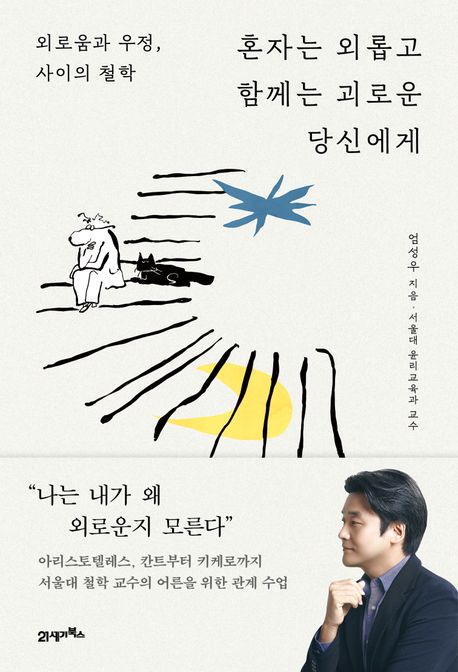
- <혼자는 외롭고 함께는 괴로운 당신에게> (21세기북스) (2025)

- <어떻게 어른이 되는가> (추수밭) (2025)

(Co-authored)
- <서양윤리사상 (공저)> (울력) (2024)
Translations

- Mill on Utilitarianism (Routledge Philosophy Guidebooks) (2007) by Roger Crisp into Korean, <밀의 공리주의> (철학과 현실사) (2014)
Works in Progress (draft available upon request: sungwoou@mail.com)
- “The Boundaries of Honesty and Dishonesty” [draft] (under review)
[Abstract] In this paper, I aim to draw the boundaries of honesty and dishonesty in terms of the respect for the right not to be deceived, which I take to be the core attitude of honesty. First, I roughly demarcate the scope of honesty by examining what kind of behaviors are typically regarded as falling under the matter of honesty and dishonesty. I show why the behaviors that are typically said to be dishonest and why and in what conditions the cases that can be categorized as ‘dishonest’ behaviors do not necessarily manifest one’s dishonesty. Then I show some cases of apparent dishonesty and show when and in what conditions they can be morally justified.
- “Respect for Autonomy and Non-Intrusion” (with Dave Wendler) (under review)
[Abstract] The philosophical literature on the importance of autonomy focuses on its positive aspect, namely, individuals determining the course of their lives for themselves. In this paper, we describe and explore autonomy’s negative aspect—i.e., no one else determining the course of one’s life, which we call non-intrusion. We argue that this largely ignored aspect of autonomy has value independently of the extent to which it promotes or protects the positive aspect of autonomy. To support this claim, we consider a range of cases in which intrusion is problematic even though the affected individuals cannot, or do not, control the aspect of their lives in question. After establishing the independent value of non-intrusion, we consider two cases, coercion and paternalism, which illustrate the extent to which non-intrusion is central to respecting the autonomy of others, even when they do exercise positive control. This analysis suggests that non-intrusion is a vital part of respecting others, and to ethics more generally. We thus close by briefly considering a vital question for future research: Does the present analysis suggest that we need to reconsider the relationship between the positive and negative aspects of autonomy?
- “Friendly Hope and Epistemic Partiality”
[Abstract] We often seem to be epistemically partial in forming beliefs about our friends who are near and dear to us. Simon Keller and Sarah Stroud argue that good friendship not only often accompanies such differential epistemic practices, but also demand them at least sometimes. Good friendship, they say, sometimes demands some sort of epistemic partiality that is objectionable from an epistemic point of view. This paper aims to examine the relationship between friendship and epistemic partiality. First, I argue that what good friendship involves as its constituent part is not epistemic partiality per se, but what I call friendly hope. Second, I address the concern that friendship can be an epistemic vice, since, even if it does not demand epistemically objectionable partiality, it frequently gives rise to such partiality. Finally, I argue that the epistemic partiality associated with friendship is not epistemically objectionable as it first appears.
- “Mozi on Inclusive Care and Filial Piety”
[Abstract] In this paper, my main aim is to give a plausible interpretation of how Mozi’s doctrine of inclusive care ‘jian ai (兼愛)’ is to be harmonized with filial piety (xiao 孝). I examine how this doctrine is to be practiced in relation to special relationships, especially a parent-child relationship. As a background work, I briefly analyze the meaning of basic concepts in the Mozi. Next, I provide evidence that Mozi endorses the significant special relationships and regards filial piety as an important relational virtue. And then I suggest a possible interpretation of Mohist doctrine which can reconcile the apparent conflict between caring for everyone inclusively and being filial to one’s own parents. Finally, I compare Mohist view on filial piety with Mengzi’s view, and conclude by showing where their disagreement actually lies.
- “Virtue, Virtuous Activity, and Moral Self-Indulgence”
- “Explanation and the Pragmatic”
- “Rousseau on Human Nature: Pity and Amour-Propre”
- “Kant on Virtue and Moral Pleasure”
 Sungwoo Um